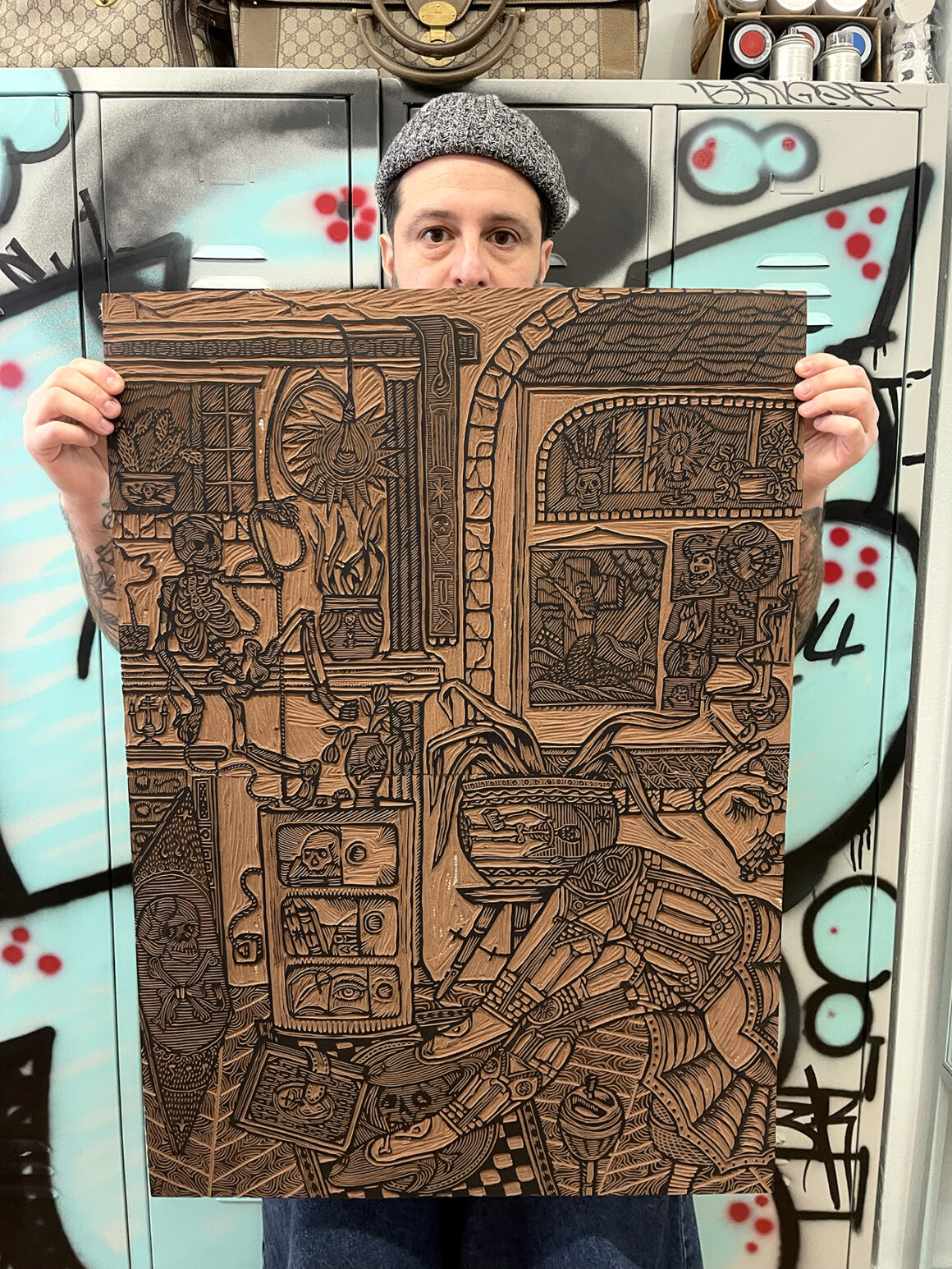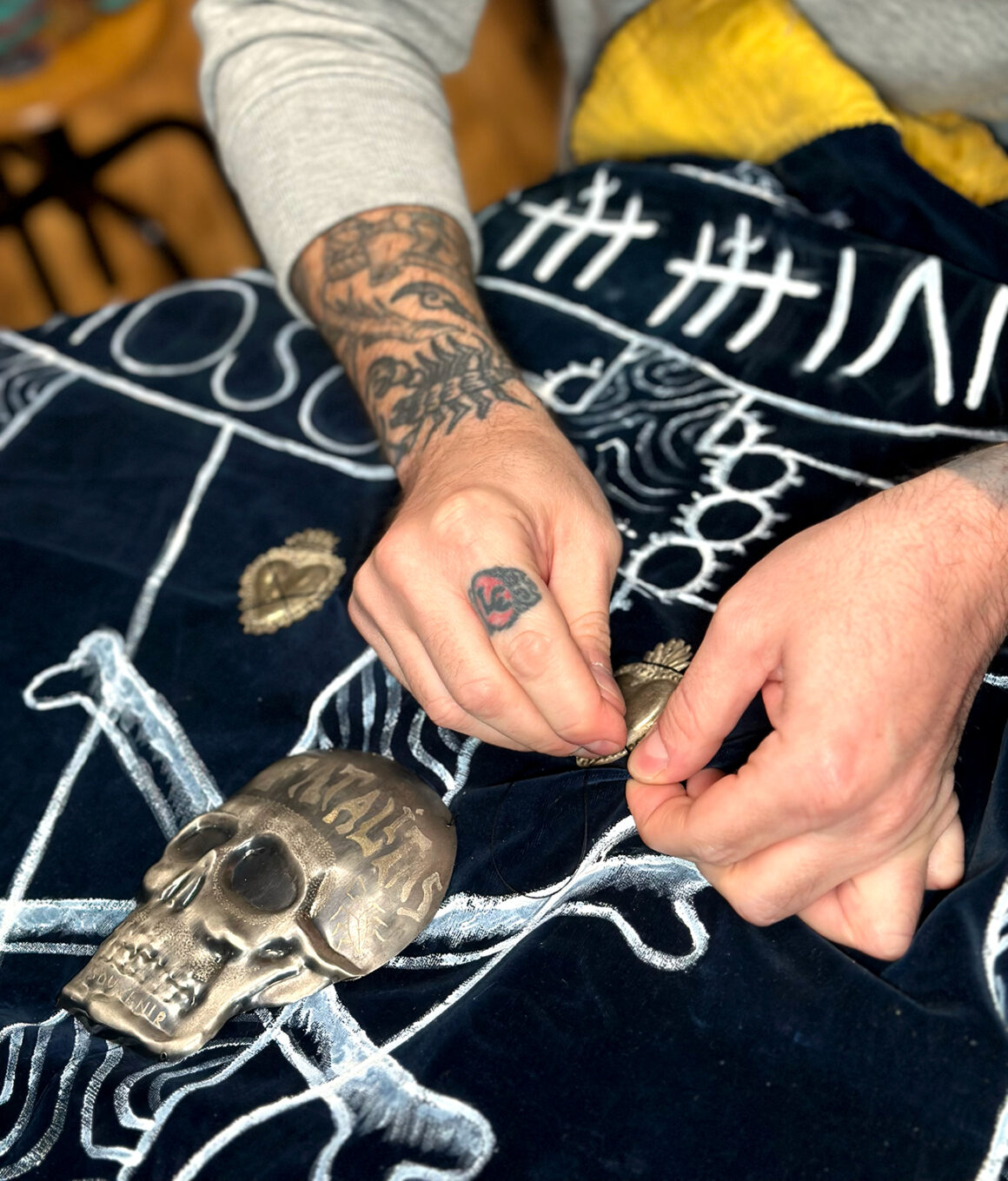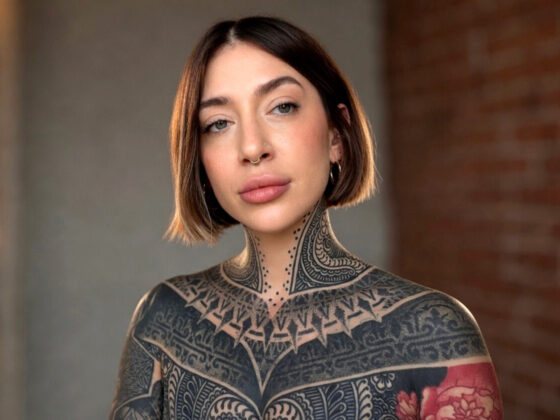


Between art history, religious symbolism, popular culture, and the memory of prison tattooing, Massimo Miai has built a personal research path that escapes traditional classifications. In his studio, LOCUSWOMB Tattoo Space, in Tuscany, tattooing engages in dialogue with fashion, graphic design, and art direction, becoming a tool to reinterpret the Italian visual heritage in a contemporary way. In this interview, he tells us about the birth of Italian Religious Tattoo, the Scheletrato project, and his way of conceiving the body as an architectural structure in constant evolution.
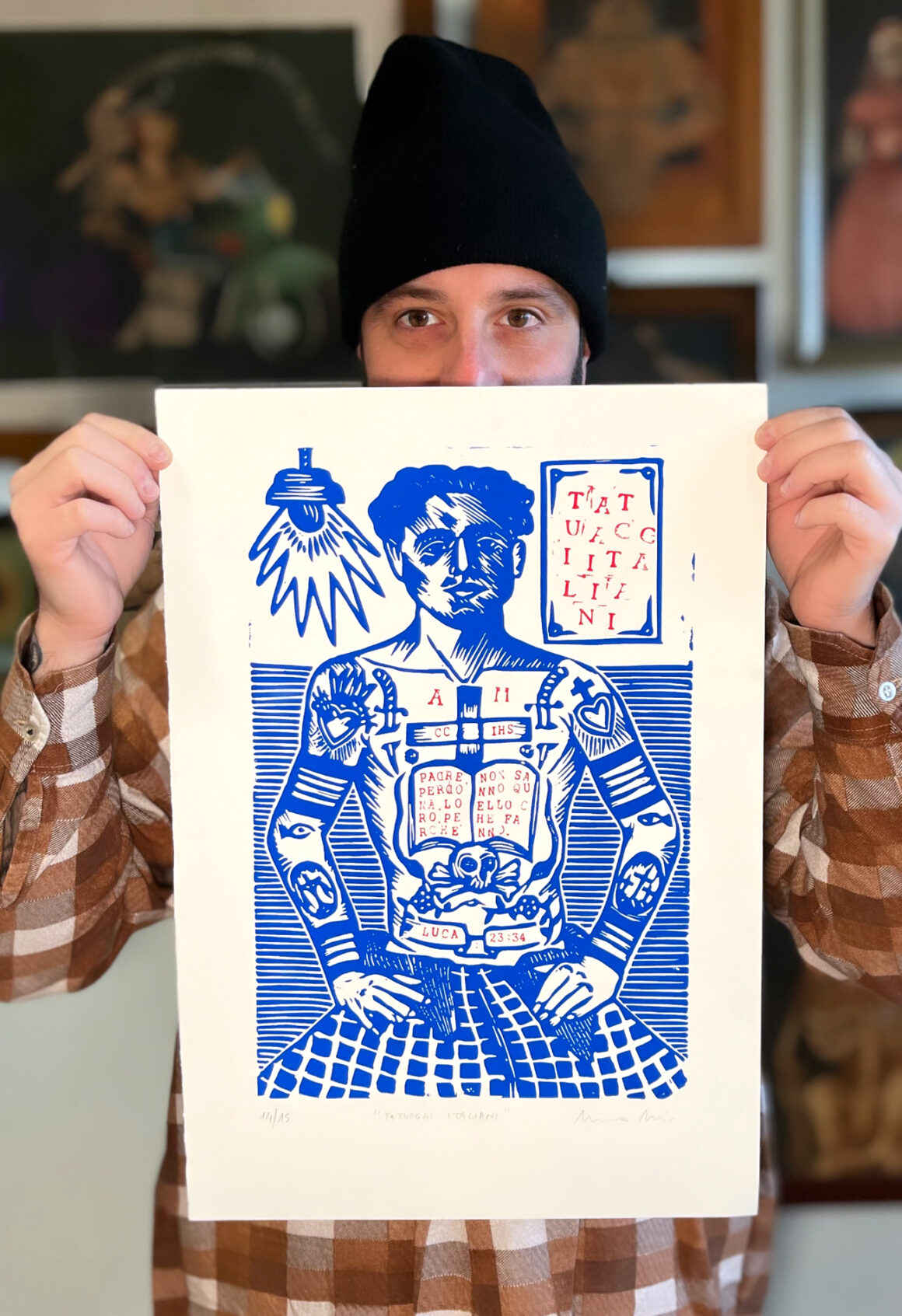
Massimo, would you like to introduce yourself to our readers?
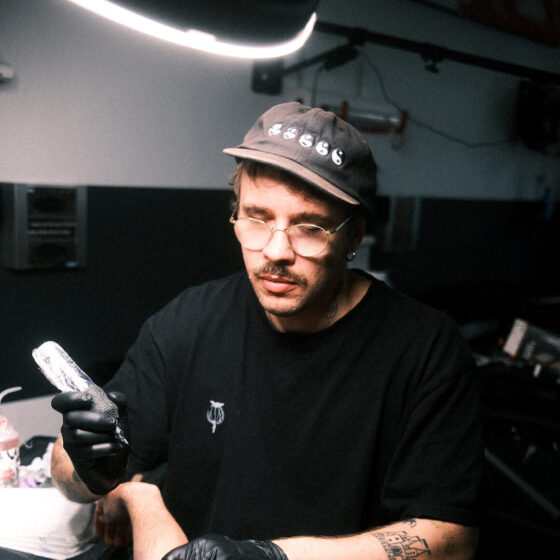
My name is Massimo Miai, I am a tattoo artist and I work in Tuscany, between Florence and the Mugello area, where I founded LOCUSWOMB Tattoo Space. It is a space that was not created as a tattoo studio in the traditional sense: it is a broader environment, where tattooing interacts with art, fashion, and design. My work develops around a personal research project that I have been carrying on for years, in which tattooing becomes a contemporary visual language built from Italian culture, art history, and an approach deeply connected to the body as a structure. At the same time, I pursue projects related to graphic design, fashion, and art direction—they are not separate activities; they are part of the same journey.
How did you get into this profession?
I discovered tattooing on the street when I was young. I used to see “prison-made” tattoos, and they fascinated me in a visceral way—not only because of their themes, but because of their visual impact and the human weight they carried. Thinking about the personal story contained within a specific mark on the skin intrigued me enormously. Then came the older guys, the first studio tattoos, the flash sheets printed directly from tattoo books.
As soon as I could, I rushed to get one myself.
The first time I entered a tattoo studio, a whole world opened up before me: it was like crossing the threshold into a parallel universe, a secret place full of objects and drawings, each with a meaning waiting to be discovered. From that moment on, my dream was to become part of it.
I spent a long time attending conventions and tattoo shops as a tattooed enthusiast—but I never felt ready to truly begin. I saw tattooing as something magical, something that required an enormous amount of historical study. So I studied. For a long time. Until one day I started tattooing myself to understand whether I could really do it. Something good came out of it, and from that moment my professional journey began.
Your style intrigues me because it is linked to prison tattooing. How did your stylistic journey develop?
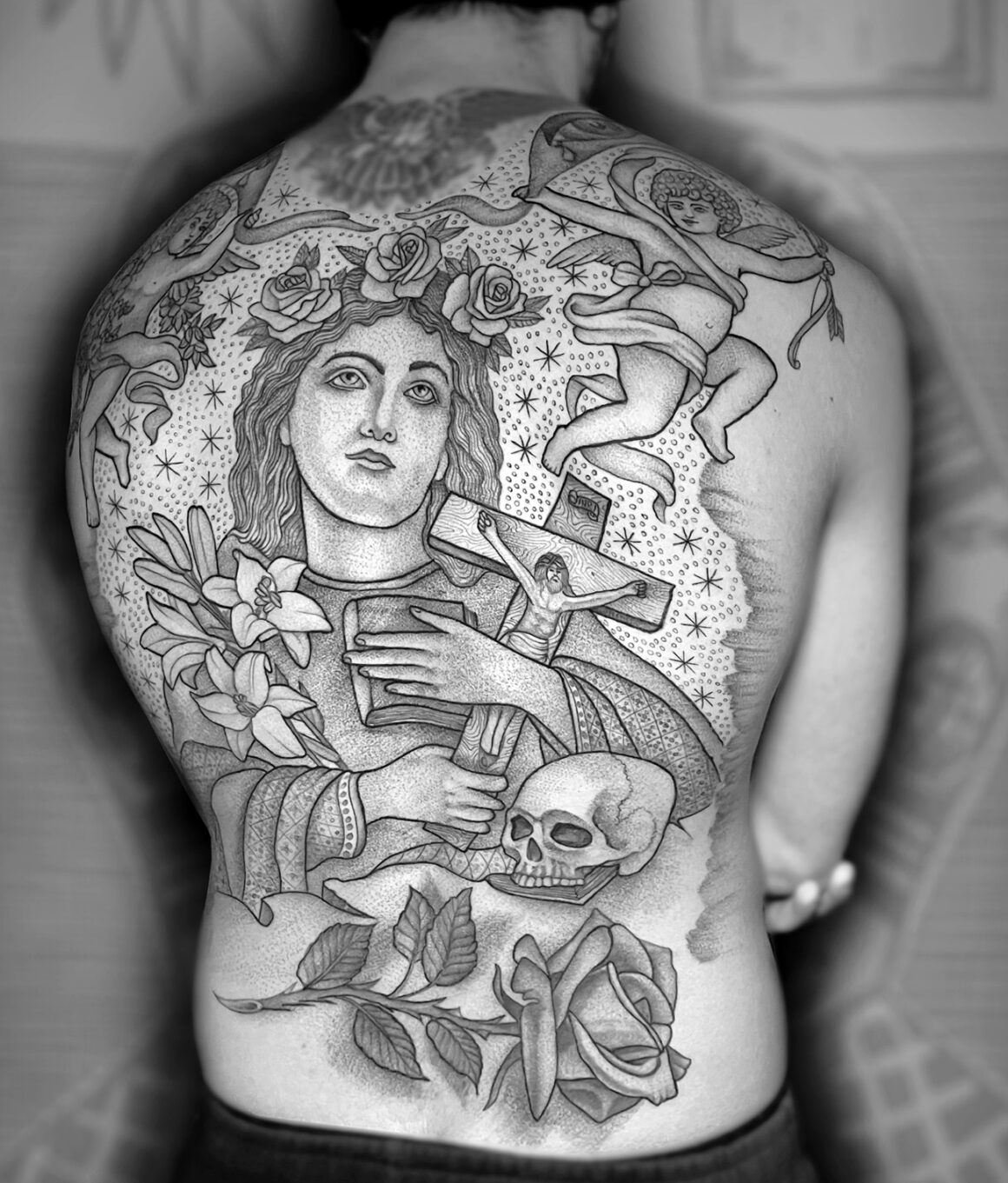
At the beginning, I wasn’t looking for a style. I was looking for a direction. I was obsessed with what was happening in the tattoo world: new movements, new languages, artists coming from graphic design, illustration, and contemporary art. Up until that point, tattooing had been defined by the great established traditions—the American old school, Japanese tattooing, tribal tattooing in its many forms, the first realistic styles. But around me something irreversible was happening: an entire generation of new tattoo artists was bringing with it an unprecedented cultural background. Ancient engraving, typography, Photoshop layers. I came from the world of graphic design and immersed myself in it without hesitation.
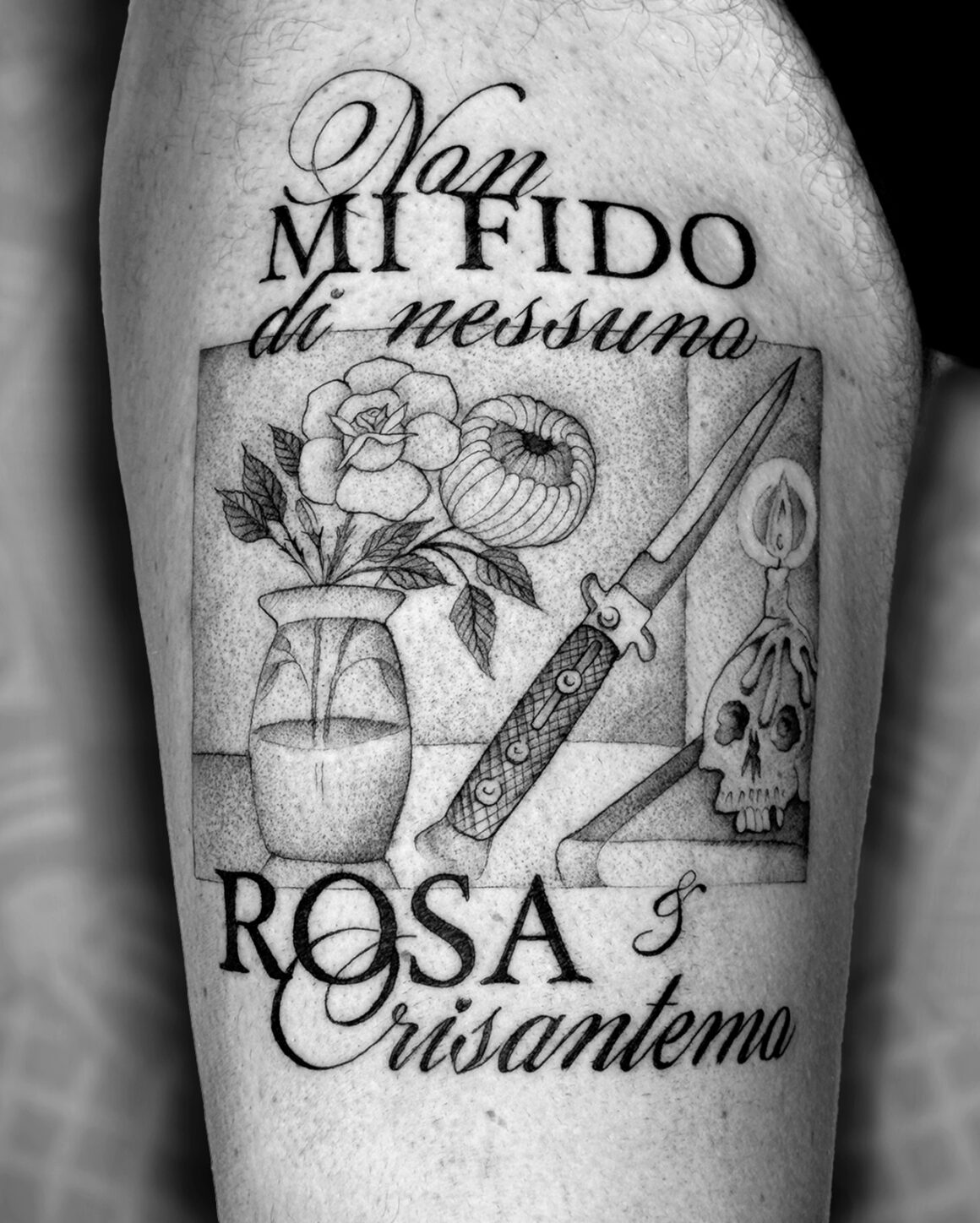
It was during that period that the first articles about prison tattooing began to circulate. Something clicked in me. I searched through books and trade magazines, I spoke to people who had truly experienced it, and I found the first videos circulating online. I focused on the main prison tattoo styles: Russian, Chicano gang tattooing, French labor camp tattooing, and Italian prison tattooing. From each one, I extracted the technical aspects that struck me the most.
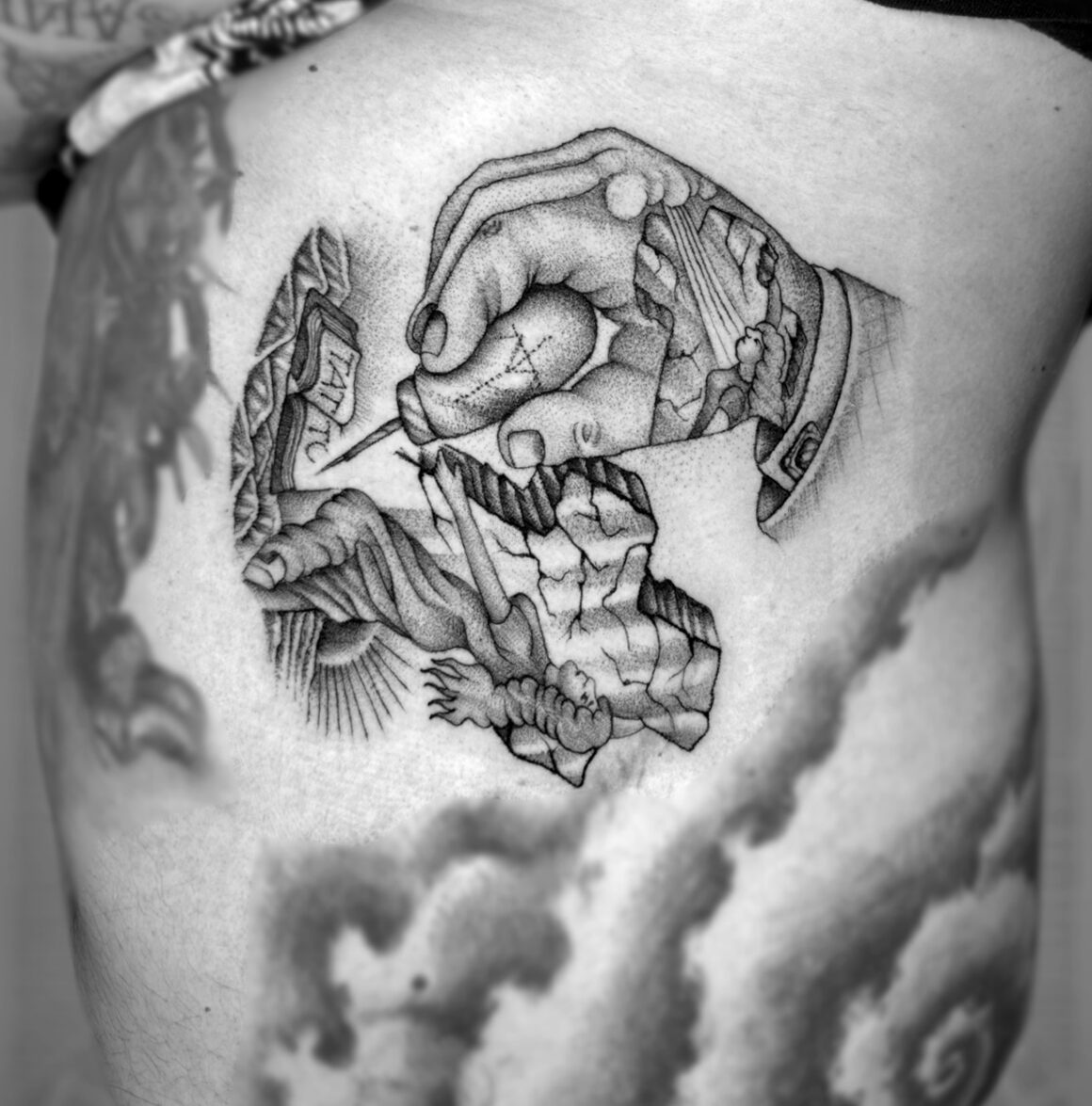
From the Chicano style: the shading made with single needles that creates an almost delicate effect, the densely filled bodies where every space becomes filler, generating optical overlaps as if everything had been planned from the beginning. From Russian Criminal tattooing: the strength of the almost graphic lines. The hatchings, the lettering, the rougher and more direct stippled shading.
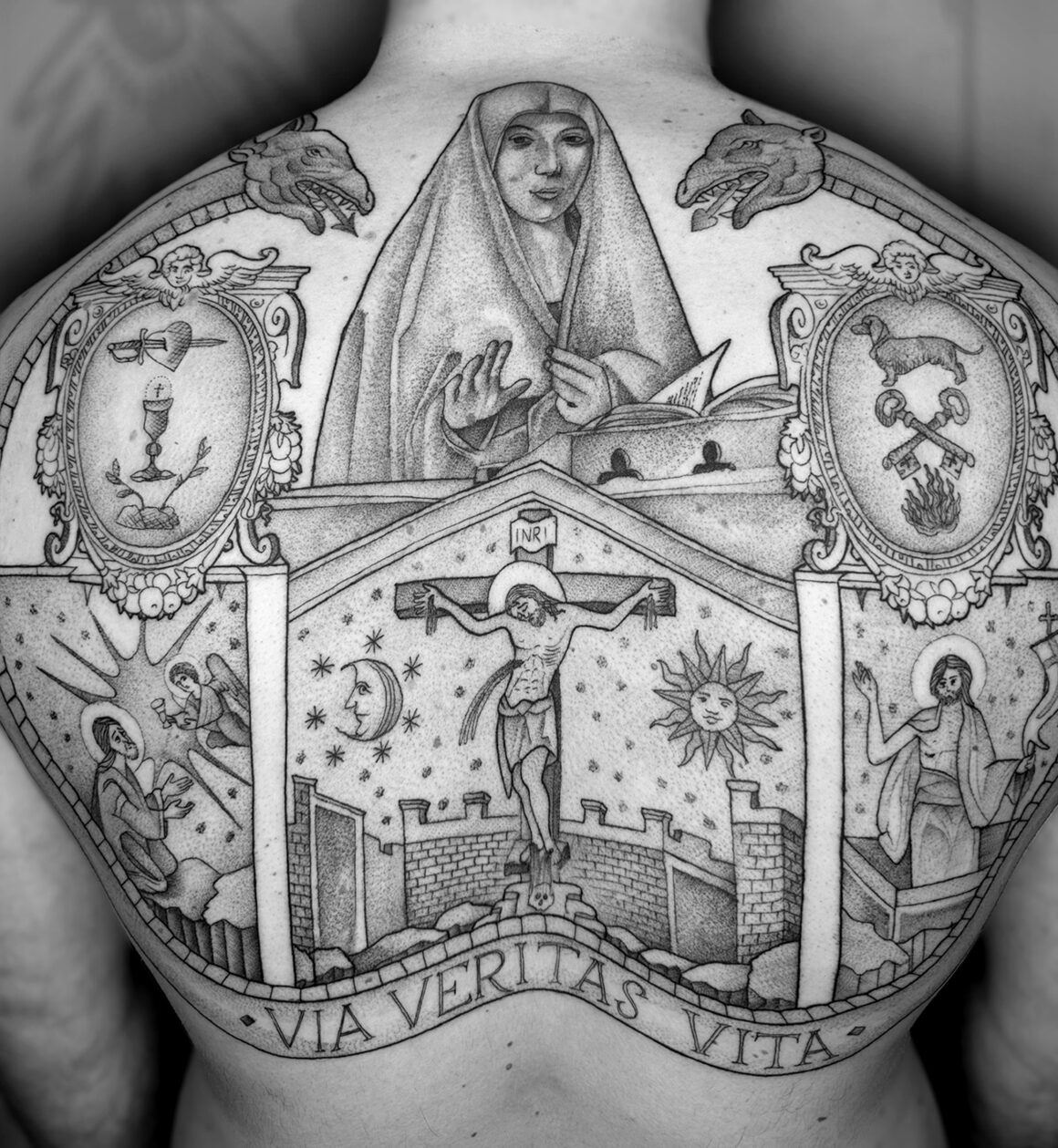
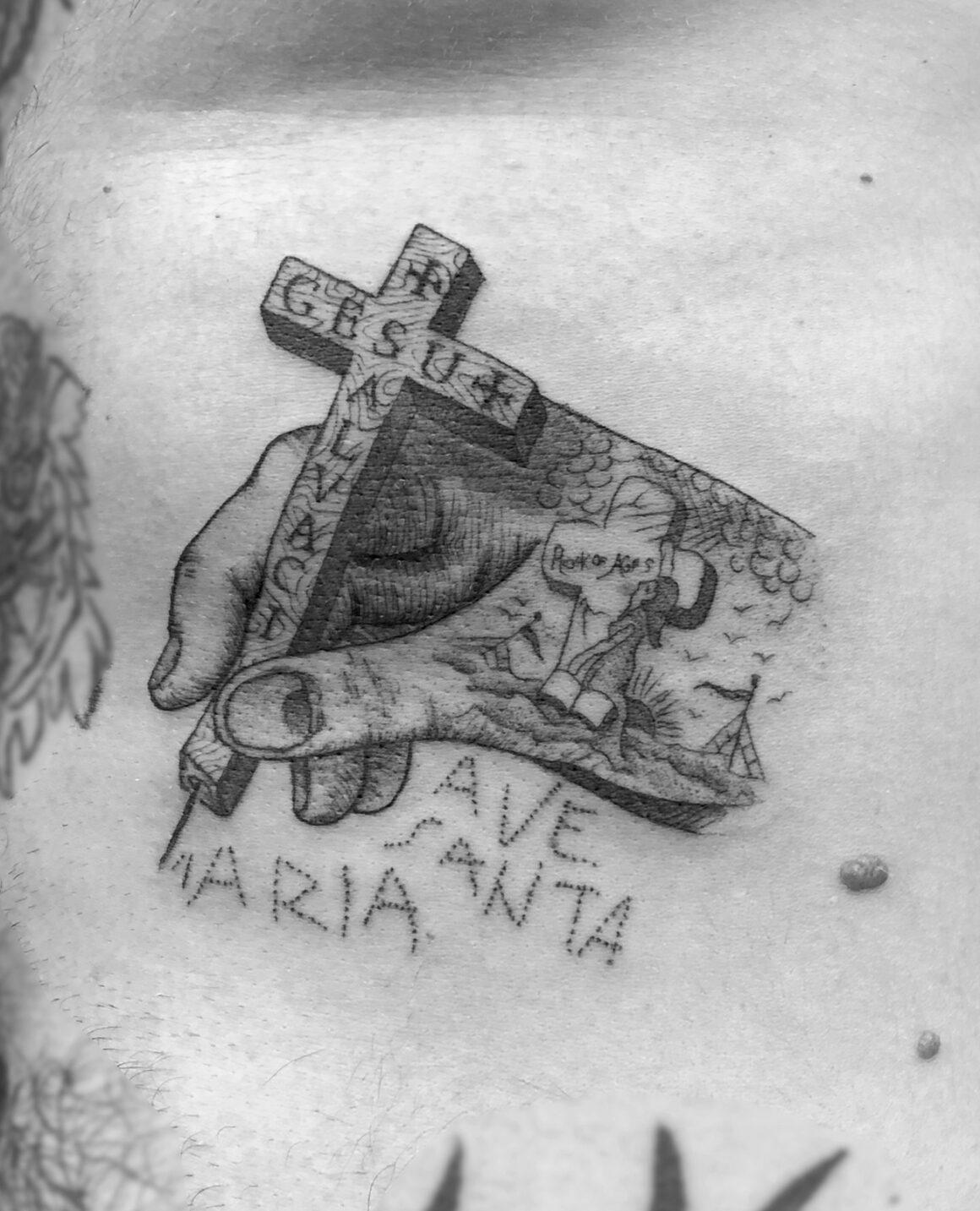
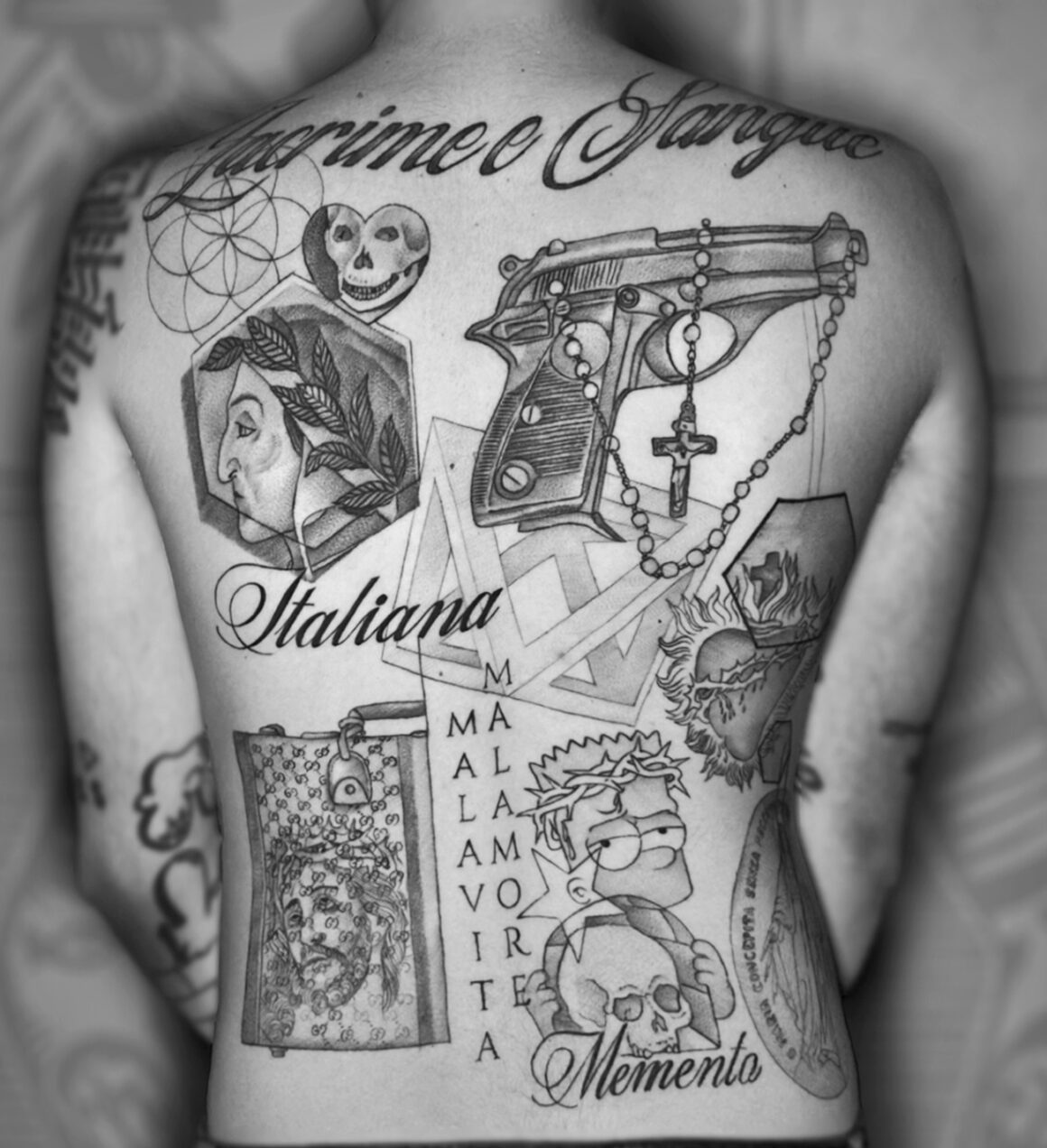
From the French Labor Camps: the radical simplification of images through a few essential lines, and above all the placements and compositions that interact with the body. And finally the Italian tradition: from the Loreto tattoos to L’Uomo Criminale inherited through the research of Cesare Lombroso, where symbolism overrides aesthetics and direct, grammatically incorrect inscriptions become pure unintentional poetry.
Once I understood the visual context, I went back to the roots: I tried to understand the method through which those tattoos were created. Homemade machines, a single needle for lines, shading, and fillings. A limitation imposed by necessity.
I had to recreate that stylistic situation.
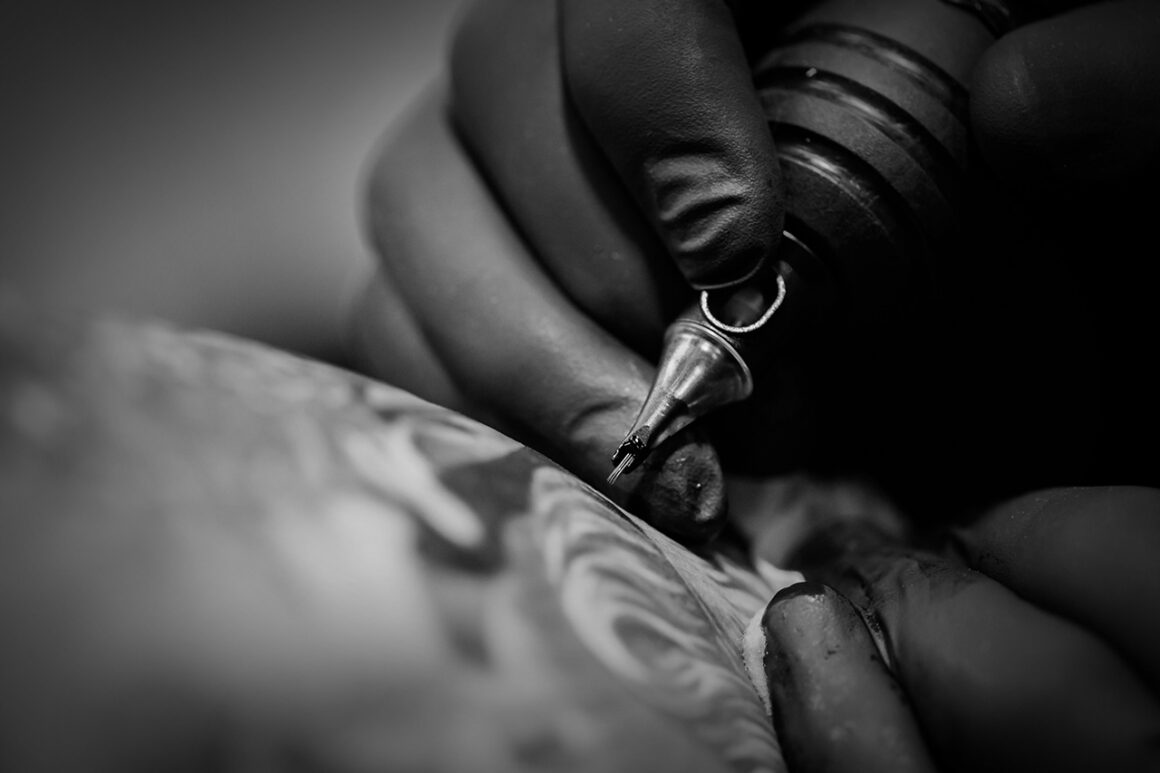
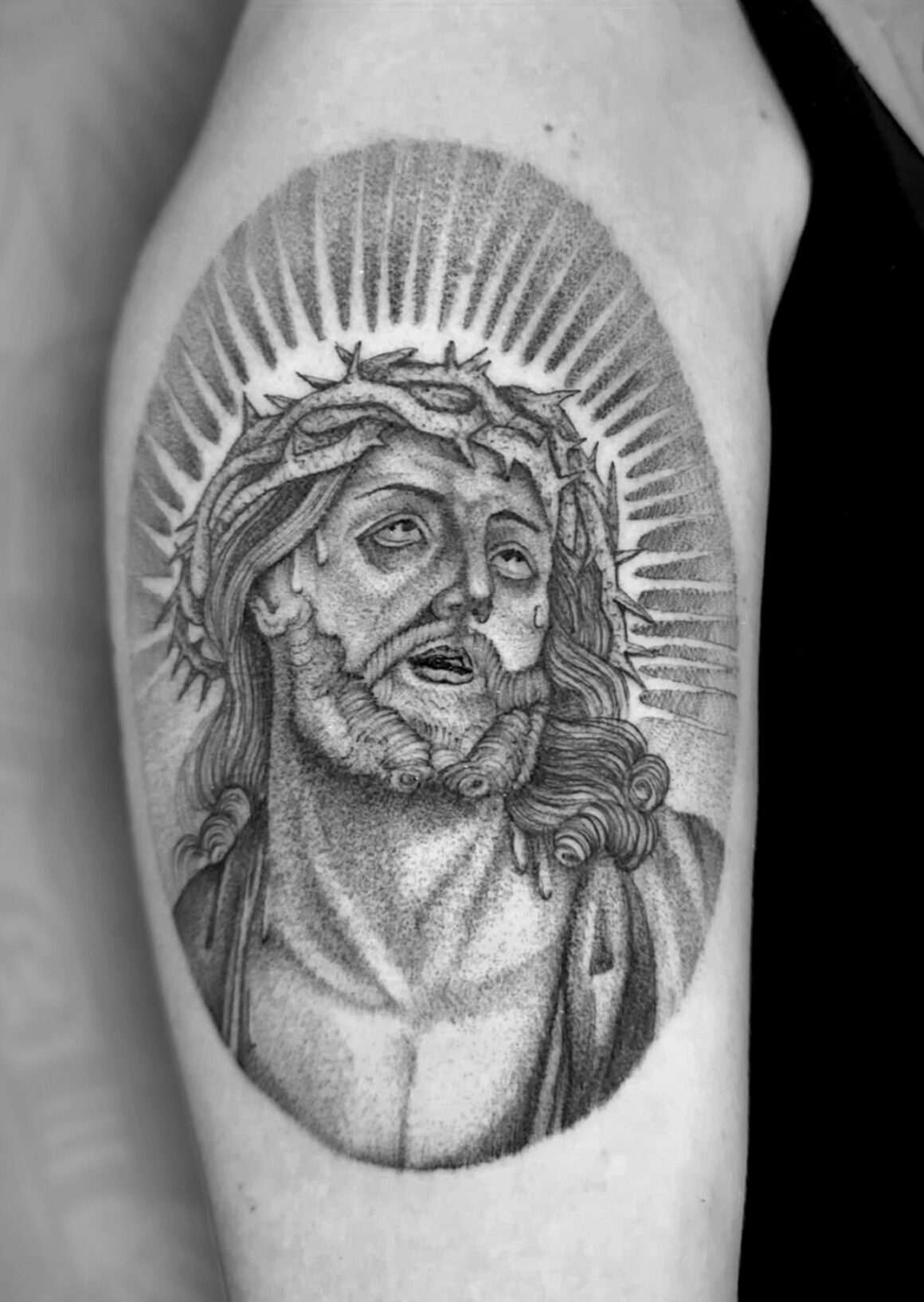
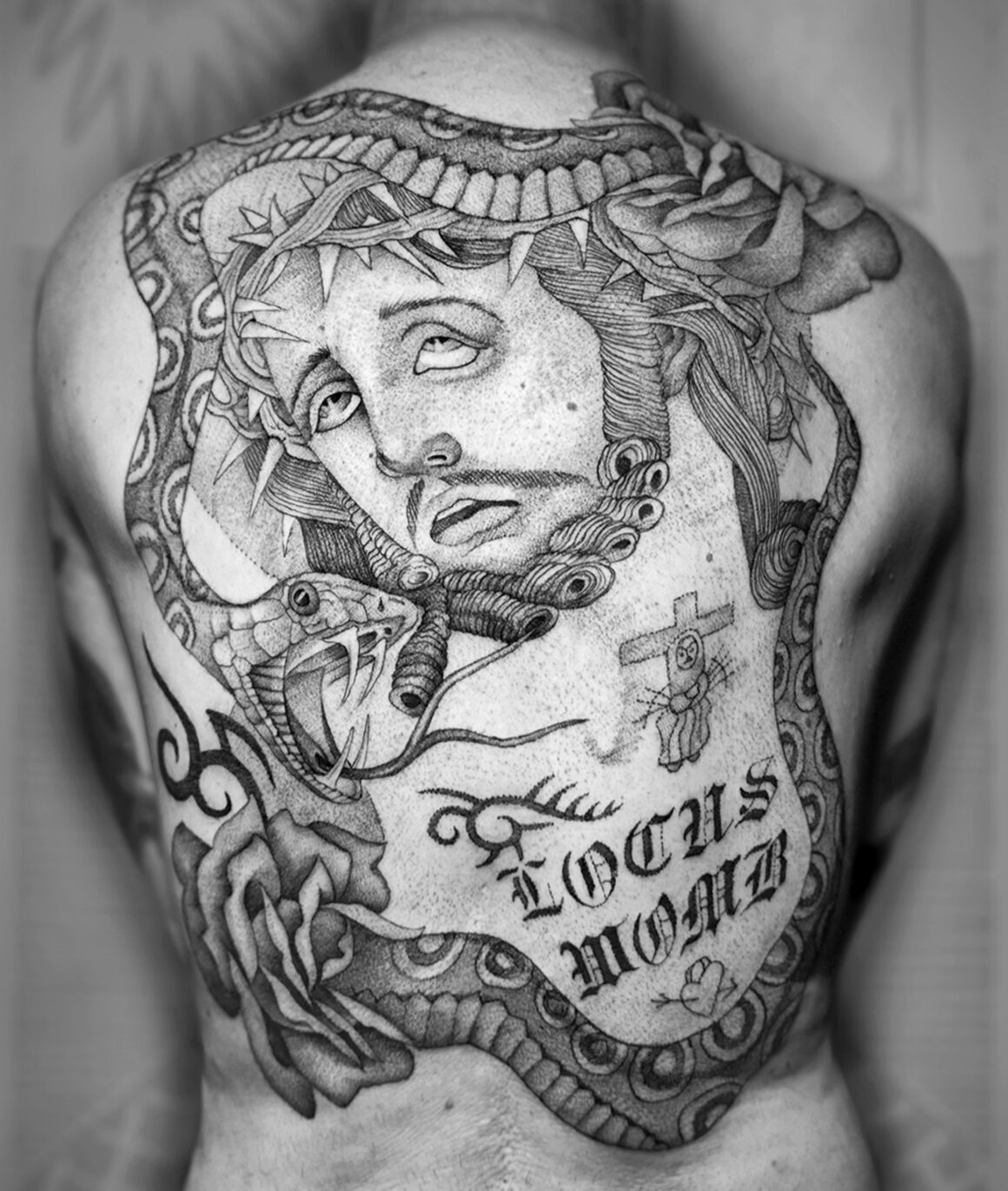
I tried to reproduce those technical “deficiencies” caused by improvised equipment and by the speed of execution imposed by the fear of being discovered. I did it using everything available today—machines and needles of every kind—but the result did not satisfy me. It was too precise. So simplification became my starting point. I forced myself to use only the bare minimum: a single needle, black ink more or less diluted, and as little time as possible. The shading is created using very thin liner needles that, when run quickly, bounce on the skin, leaving tiny dots. At first the effect appears rough, but over time, as the tattoo heals, the dots move closer together and blend, creating an aged effect that is very direct, but also soft and elegant.
Today your work is linked to religious iconography, seen more as an Italian cultural element than as an act of faith. Can we define your work with the expression “Italian Religious Tattoo”?
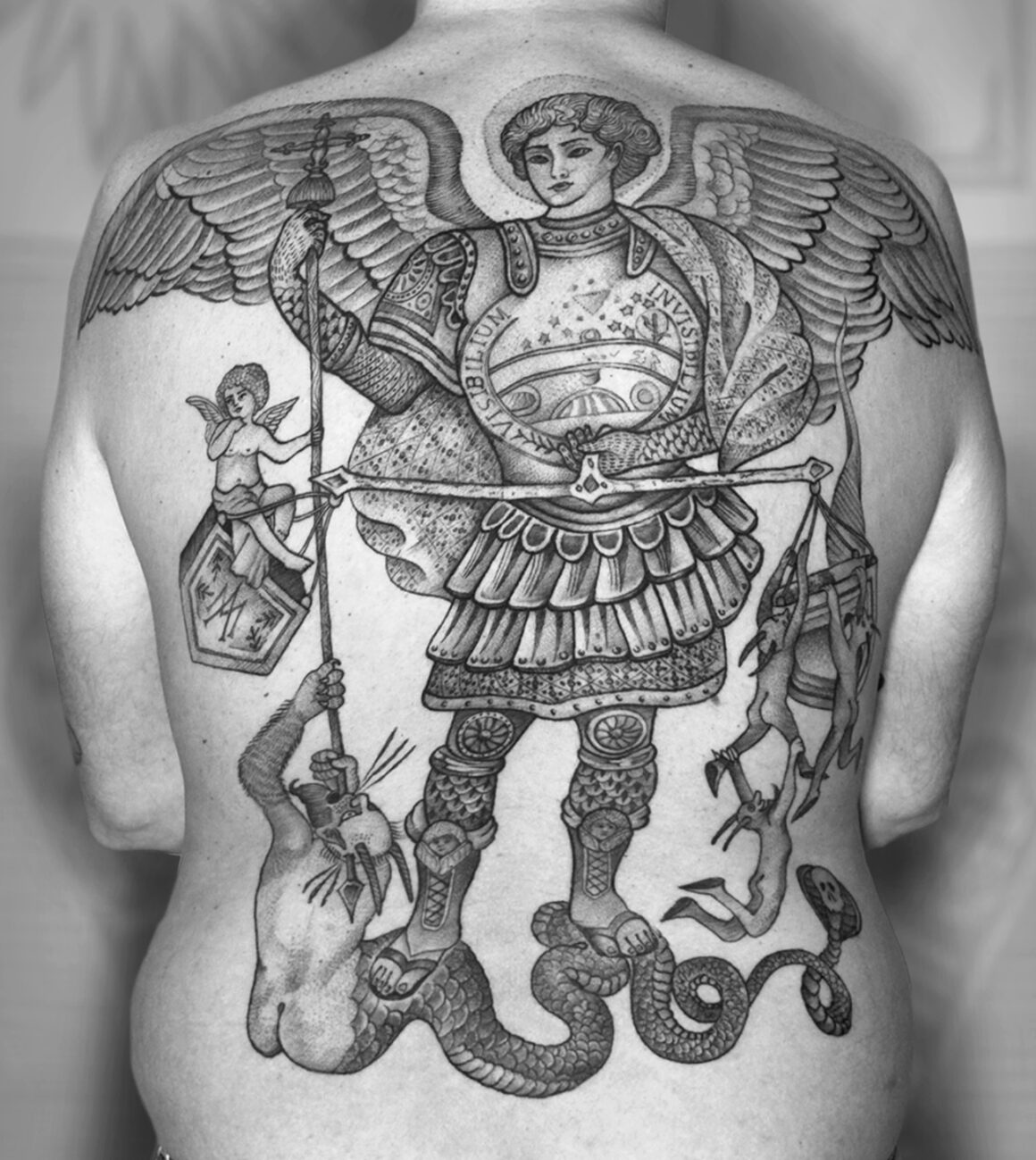
Yes, exactly. Italian Religious Tattoo is the name I gave to this project, considering it a true contemporary Italian tattoo style. It is not a religious style. It is not an act of faith, nor a declaration of belonging to the Church. When I began to feel more confident technically, a question arrived that changed everything. Was it possible that tattooing had never really existed in Italy? I decided to look for it seriously.
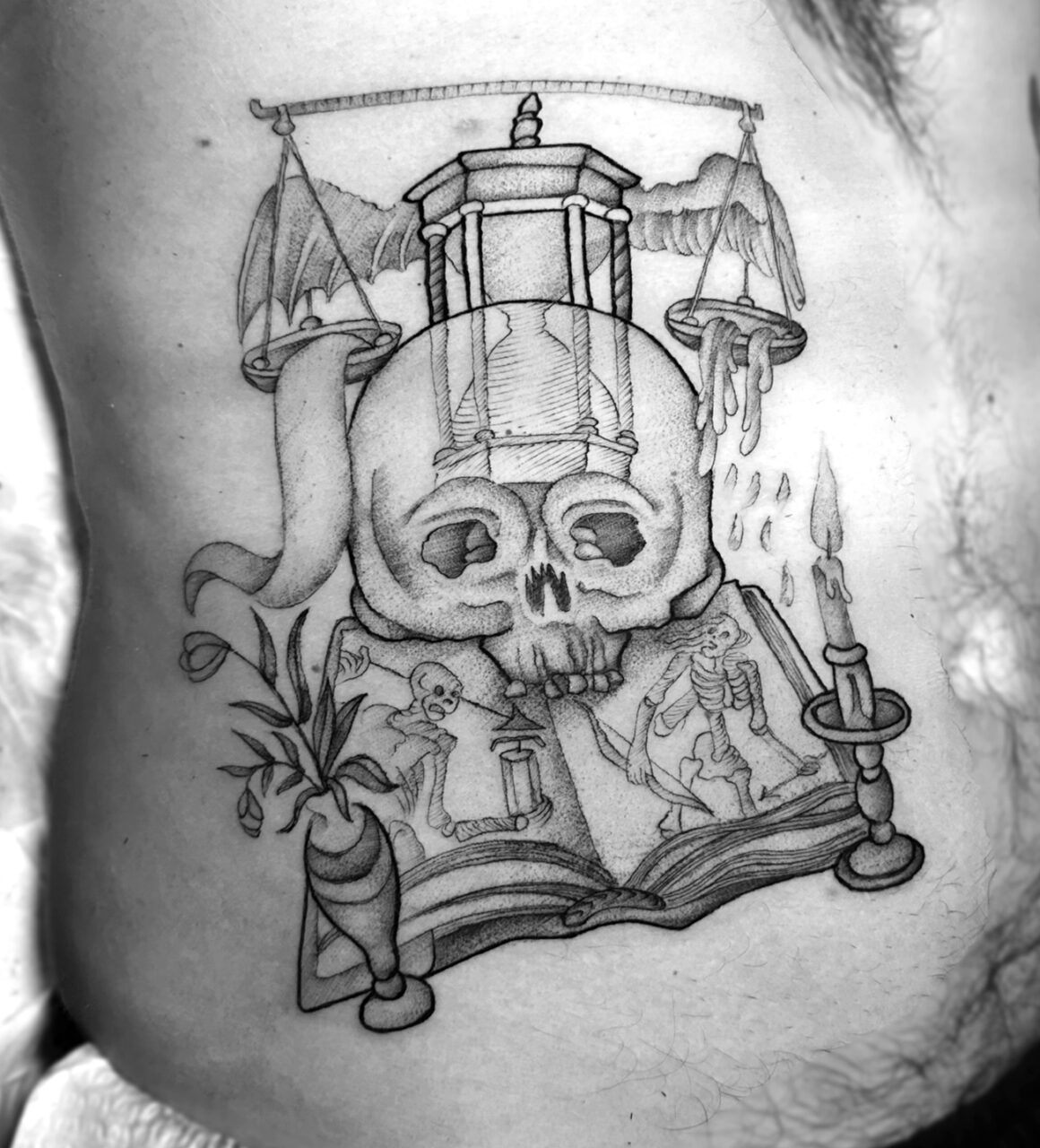
I discovered the Loreto tattoos, the research of Cesare Lombroso, the traces left by persecuted Christians, the marks of slaves, up to the “modern” tattoo associated with criminality. The thread connecting all of them was thin but very clear. Italian tattooing had always existed, but within restricted, almost secret communities and almost always connected to faith, which never developed into an evolutionary movement. Italy did not have a style in the modern sense of the word, but it had an incredibly powerful visual imagery, capable of merging with my technical research into prison tattooing.
I have always been fascinated by symbolism as a key to interpreting a work of art.
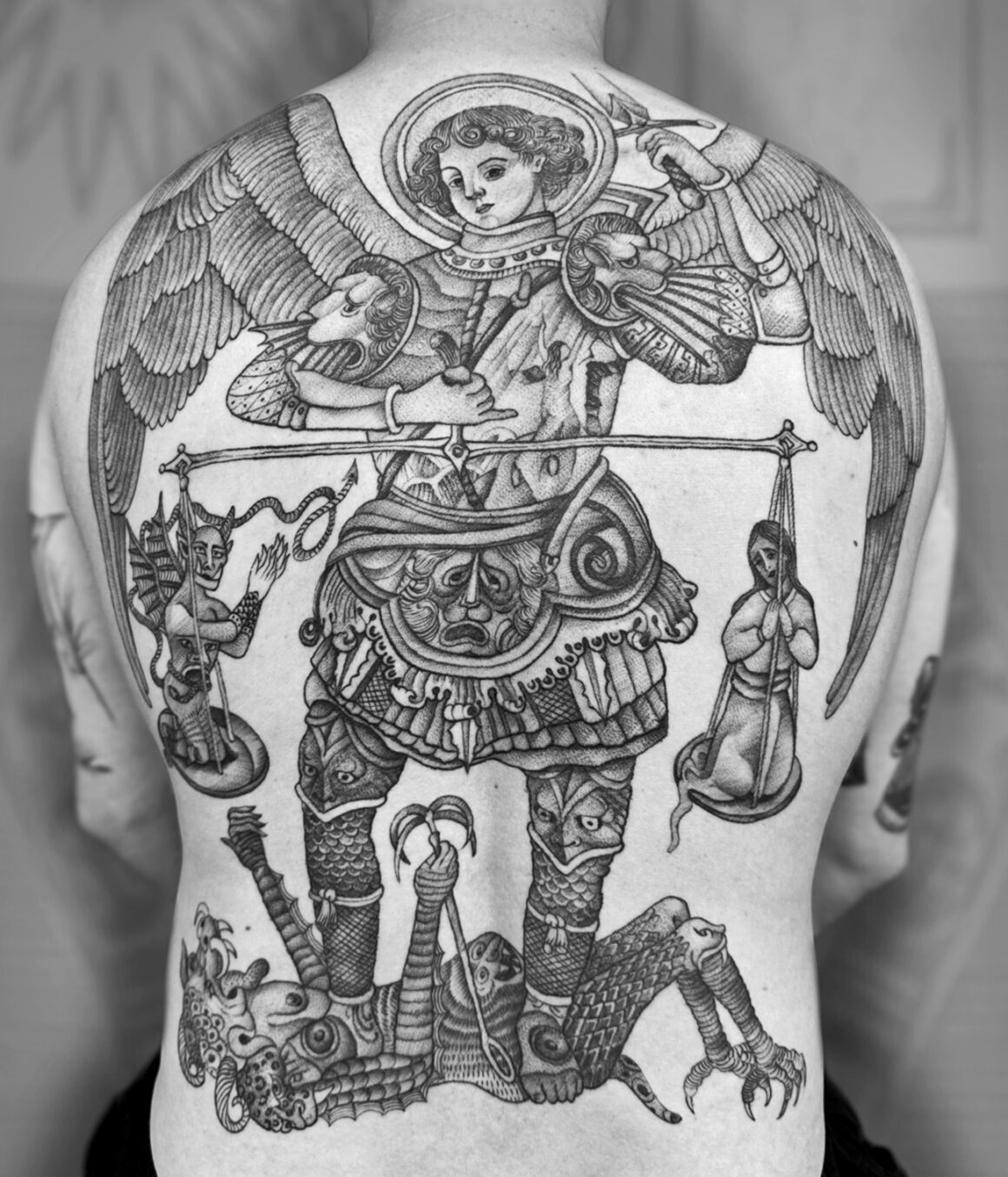
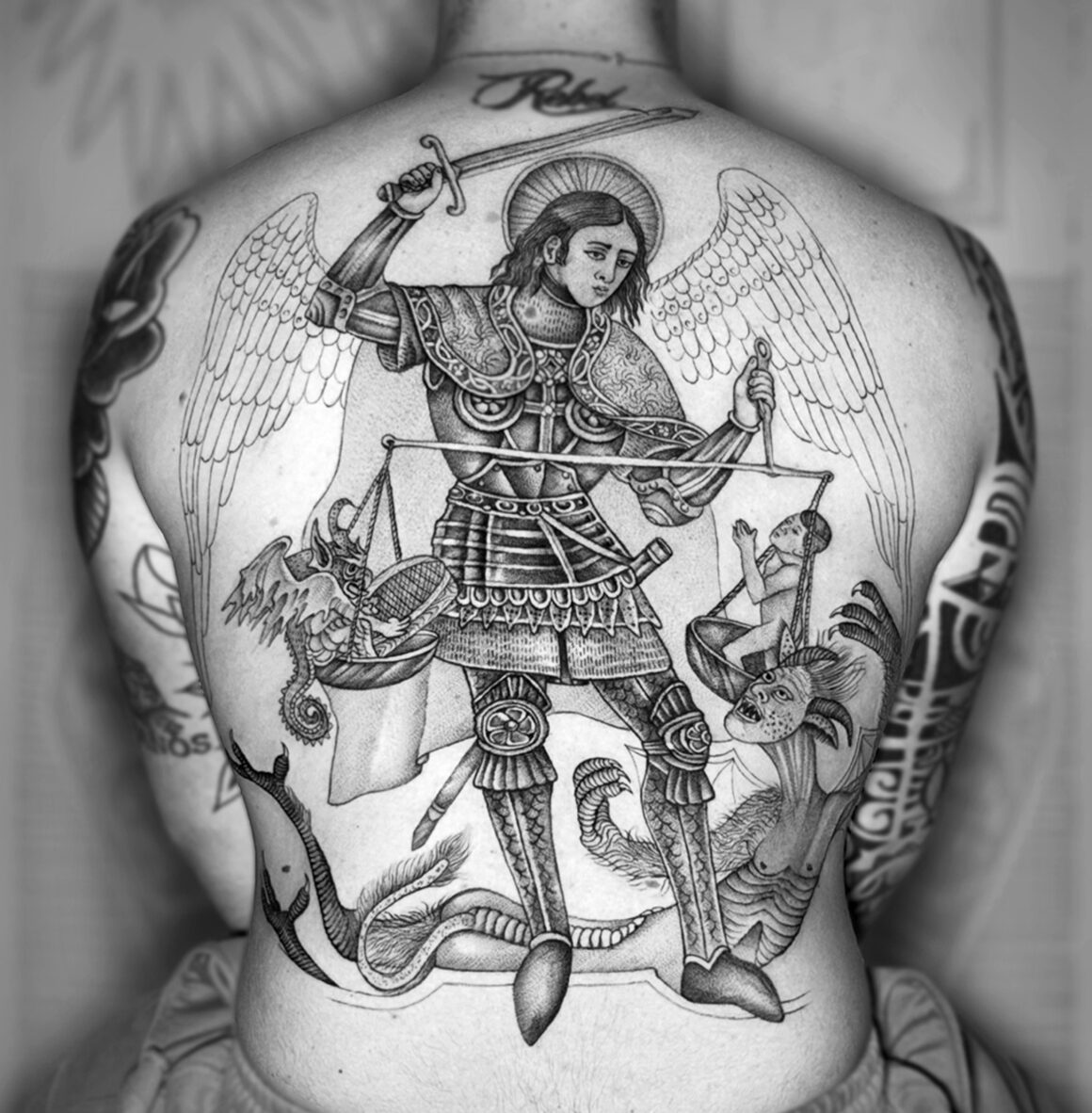
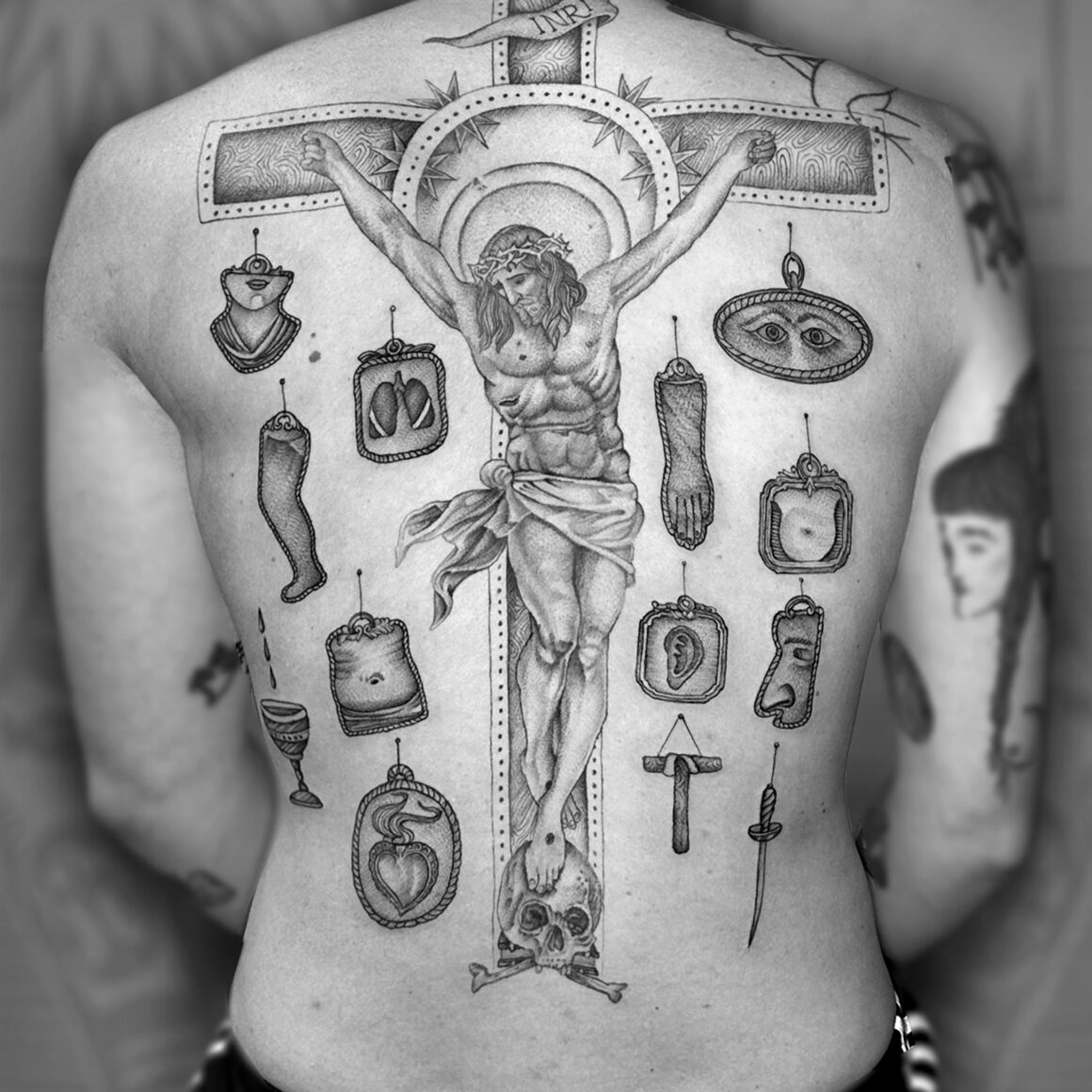
The ability to look at a painting and—through study—read a story within it. I have always been attracted to alchemical, esoteric, Masonic, and religious symbolism. Different worlds, often built on the same archetypes. The same applies to literature. Biblical stories, the Psalms, the Divine Comedy, Latin mottos. Italian Religious Tattoo is this meeting point: a visual language born from Italian popular religious culture, but one that goes beyond it, expands it, and reinterprets it.
I imagine that sacred art is an extremely important source of reference, especially Italian sacred art. Is that correct?
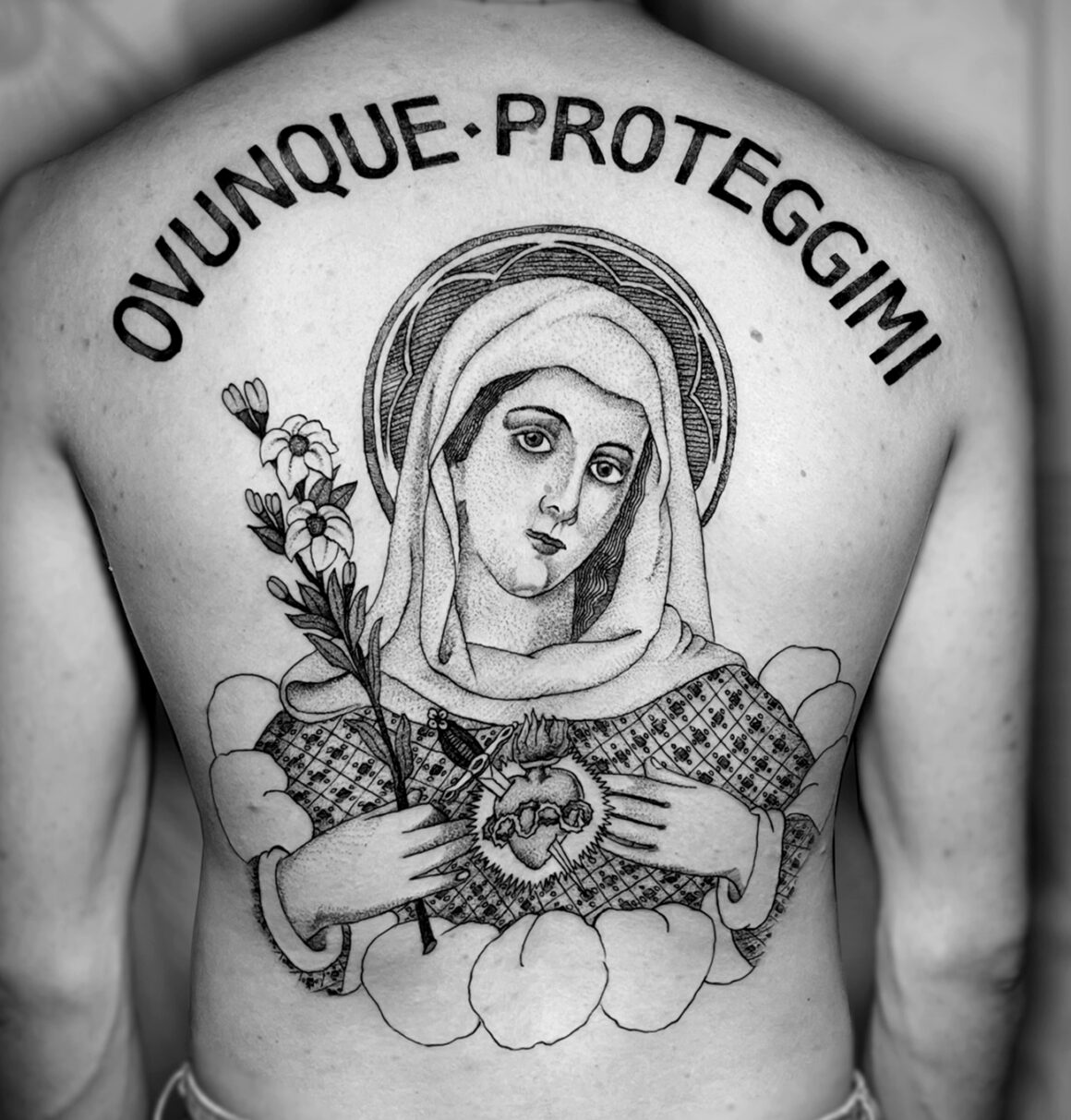
Actually, my research embraces sacred art in general, not exclusively Italian sacred art. By studying art history, I understood how decisive patronage is—that is, who pays for the work. In Italy, it was the Church that financed artistic production for centuries, filling every wall, every vault, every street corner with biblical figures, saints, Madonnas, and symbols. Since childhood, we have been unconsciously immersed in this visual universe. The roadside shrines at street corners, the Madonnas in house hallways, the saints on building façades, the rosaries hanging from car rear-view mirrors. Images we did not choose, yet they entered us, generation after generation, becoming part of our visual DNA, part of our collective imagination, regardless of personal beliefs. Italian Religious Tattoo uses this iconography as a communicative tool of our country’s historical culture. What element could better represent an Italian tattoo style?
What are your main sources of inspiration, then?
My sources of inspiration encompass everything I have accumulated over time while building my background. I worked in the fashion industry as a researcher for the style departments of major brands, sourcing vintage garments on commission. This forced me to study clothing through different eras and to understand the construction of a collection in every aspect. It trained me to always look toward the future while remaining anchored to the classicism of the past.
Then graphic design helped me understand simplification, with its rules and its aesthetic taste.
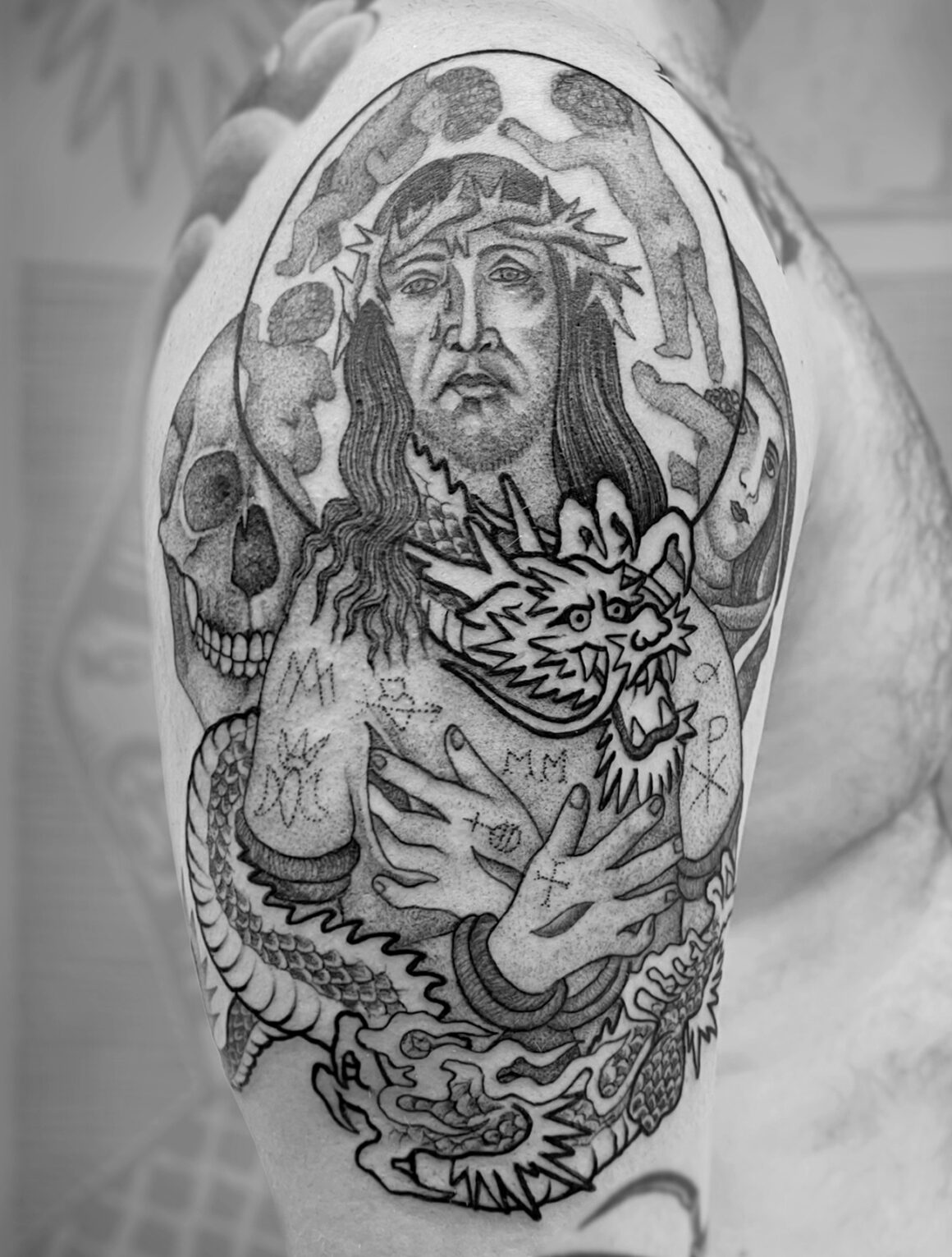
I have countless references, from antiquity to contemporary times, but if I had to choose a single artist, I would say Sandro Botticelli. In his works I find a perfect synthesis of aesthetics, symbolism, and narrative construction.
Another aspect I would like to explore is the project you call “Scheletrato,” connected to your vision of the body as an architectural structure to work on. Would you tell me about it?
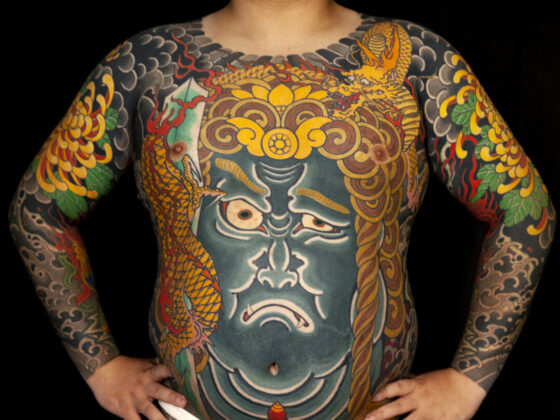
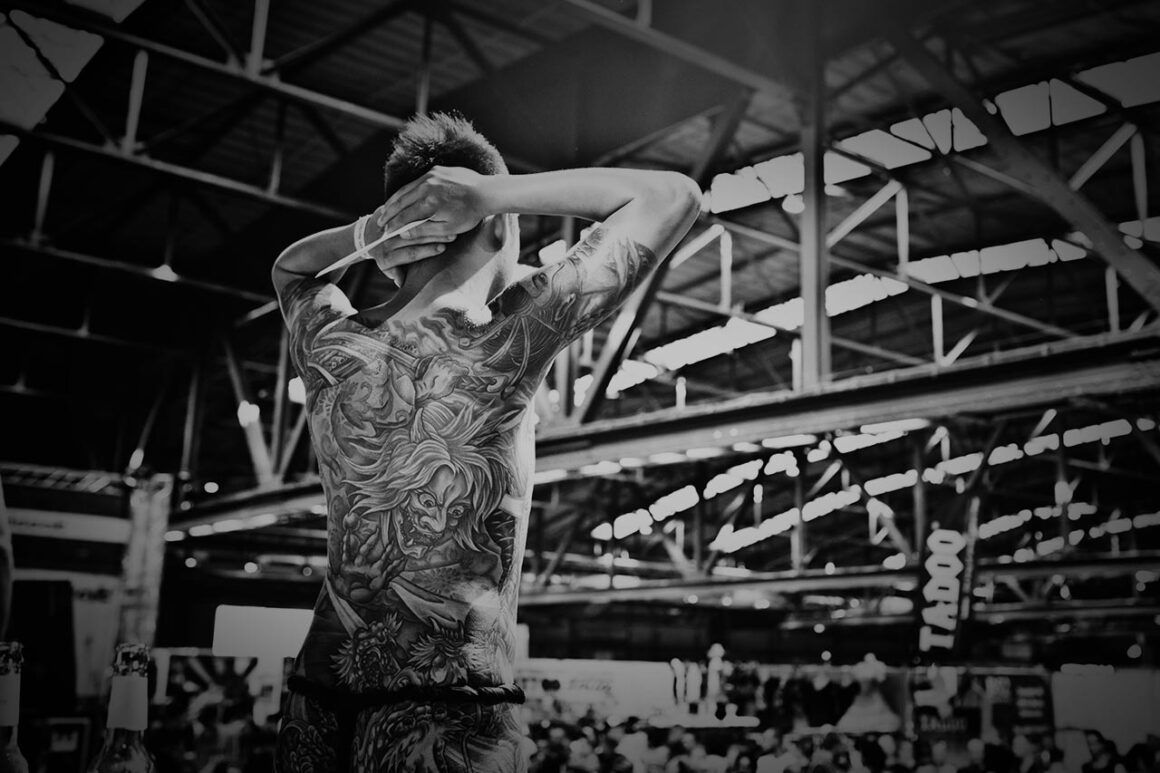
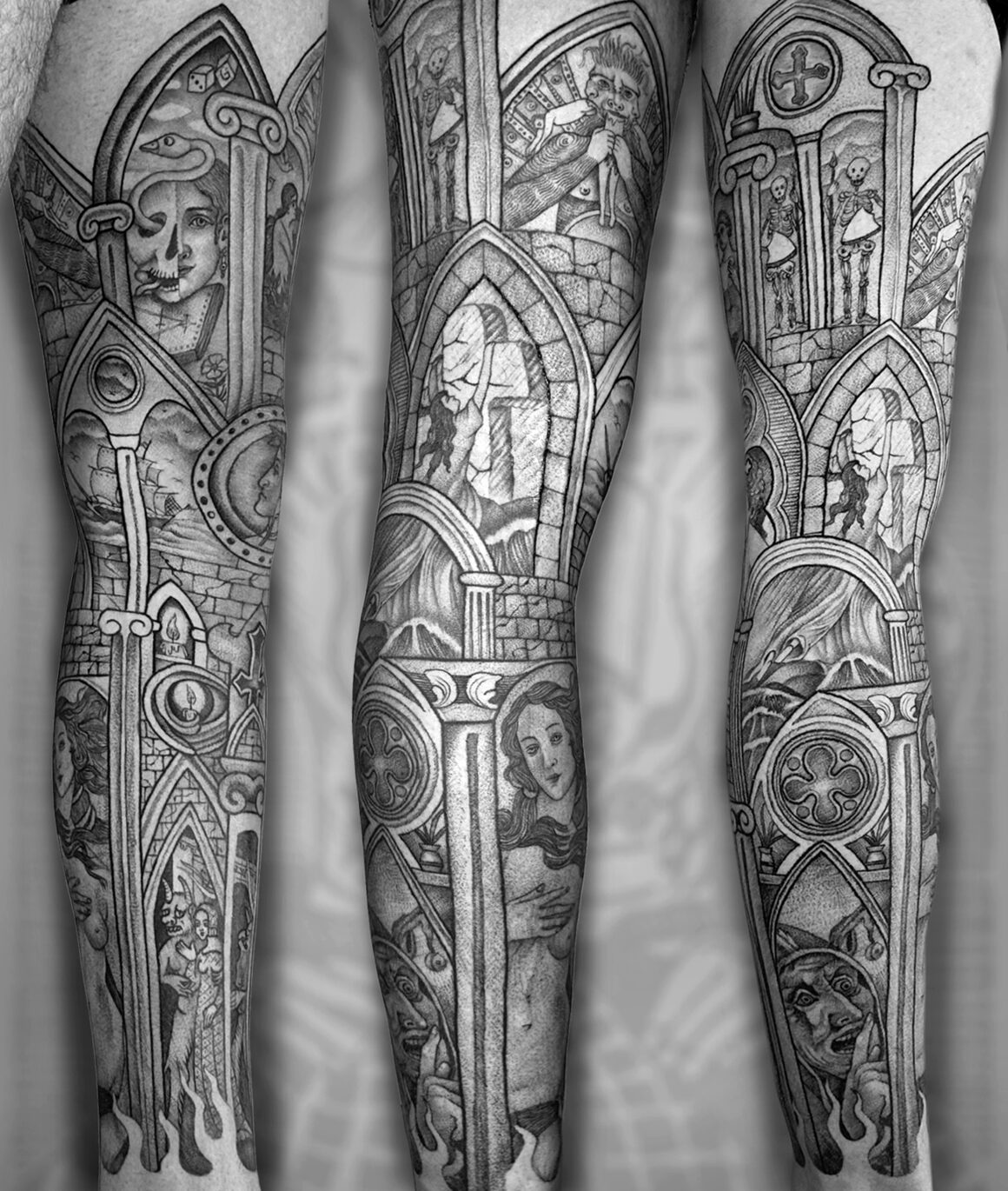
The idea behind Scheletrato is to create on the body a true architectural garment made of columns, stones, vaults, spires, architraves, balustrades, bas-reliefs, and statues. The style draws inspiration from a mixture of influences throughout architectural history: from Greek to Roman, through the Middle Ages and Gothic, all the way to the Renaissance and the Baroque.
The first phase is not tattooing, but study and research.
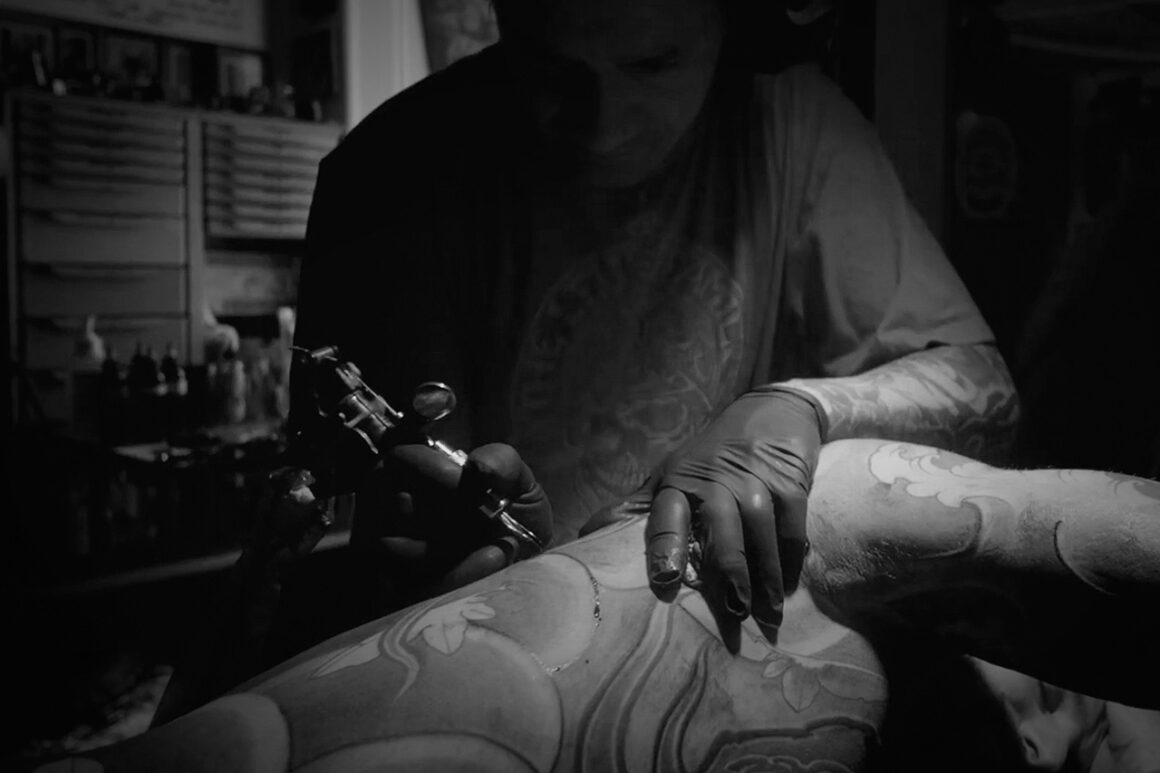
Discussion with the client to choose the elements and the story to be told. Then we move on to drawing, freehand, directly on the body. This is the key point, where the structure follows the anatomy, enhancing it and adapting to it like a tailored garment, a custom-made piece. Within the structure, I create openings of every shape and size that I call “temporal windows.” These windows are places that host the narrative without obligations or thematic rules. They can follow an autobiographical thread or accommodate subjects that are completely unrelated to one another.
It is then my technical style that holds everything together, making coherent even what apparently is not. The beauty of Scheletrato also lies in its modular nature. It does not have to be completed all at once, but can be built over time, like a building to which new floors are added. The structure alone is already a finished tattoo. The empty windows can be filled following the evolution of the person wearing it. Even old, disconnected tattoos can be incorporated into the structure, which can also cover them. Scheletrato is born with and for the person who wears it.
What steps do you follow when designing one of your tattoos?
Over the years, I have developed a method. I build or finalize the design shortly before the appointment, but from the moment I receive the request, what I call the “embryonic period” begins, during which the project lives in my head. I process it unconsciously, waiting for the right idea to arrive rather than crystallizing around the first one I find. In the meantime, I talk with the client to understand their tastes and way of thinking. I often finalize the design on the very same day, together with the client, a method that allows me to build the entire work collaboratively. I prefer and recommend sessions that last several full days: approaching tattooing without stress and experiencing it calmly is an integral part of the process.
Do you draw directly on the skin?
I do it more and more often, whenever possible. Arranging all the elements of the project on the body correctly and precisely is my priority. In Scheletrato, the structure is always drawn entirely by hand. For other projects, I prepare stencils for the main lines and then integrate the details with a marker. It often happens, and I enjoy it, that I tattoo many details directly with the machine, without references. In this way I can work with the actual spaces and evaluate the best way to approach that specific area of the body, on skin that is always different.
I know you have done several collaborations outside the tattoo sector because of your background in fashion and graphic design. Would you like to tell me about them?
Certainly. Thanks to my previous work as a researcher for fashion houses, I stayed in contact with designers and I have never really left that world behind. Over time, I have participated in many collections as a graphic designer, consultant, and artist. For 2027, I have many new developments. First of all, the launch of my website, which will also host the e-commerce platform for my brand M.MIAI. I am also working with a collective on a new streetwear brand—also scheduled to launch in 2027—but for now I do not want to spoil anything else…
Follow me!